
Born in Kampala, Olivia Mary Nantongo is part of a new generation of Ugandan artists reshaping contemporary African portraiture. In her practise as a mixed-media artist, she explores a range of media, including photography, painting, digital art, performance, and poetry. Her work centres on the female experience, featuring subjects in vibrant colours who appear confident and self-possessed. Nantongo’s portraits, often using her own body as a canvas, challenge colonial and contemporary ideals of beauty, thereby renegotiating what it means to be an African woman in today’s society. In the interview with SeaVoice, Olivia Nantongo talks about her connection to rivers and how they shape the way she interweaves ancestral wisdom and everyday objects in her art. Sharing these themes through art is a particular form of Ocean Literacy, how we influence bodies of water and how they influence us, through the lens of gender, culture, colonialism, and traditional knowledge.

Women, particularly the African female experience, are at the centre of your work. You often use yourself as a canvas, creating an alternate reality by superimposing vibrant colours or bold patterns on your face and the surroundings. For readers outside Uganda, can you describe the challenges that Ugandan women, in particular, face in their lives? How did art become a tool for you to tackle these issues?
I paint a picture by grounding it in daily realities: for example, I tend to evoke the weight of gender expectations, economic barriers, or limited access to education. Then, I contrast that with my art - a kaleidoscope of resilience, where each colour or pattern is a step toward self-definition. In this way, my art isn't just a reflection - it's a rebellion, a vivid map guiding them toward a future they can paint themselves.


Nature encompasses both masculine and feminine energies, but it is often associated with culturally feminine aspects, such as Mother Earth or Mother Nature. Since your work revolves so much around the female experience, do you believe women have a special way of connecting with nature, especially with bodies of water? Is there any intangible cultural heritage that bodies of water carry?
There's this ancient undercurrent, like a river whisper, flowing through many cultures, where women and water are entwined like two vines. In some African traditions, for instance, rivers are seen as ancestral veins, carrying the wisdom of matriarchs. Women often become custodians of that flow, whether they gather at the riverbank or use water as a ritual space. So, yes! There's this intangible heritage, a kind of liquid memory, that women often access through water's pulse.

Is there something that you have learned personally or as an artist from a body of water?
It's like a tidal dialogue, a conversation that stretches both ways. Personally, I grew up loving rivers and lakes, and every ripple became a pulse inside me. As an artist, I transform that intimate connection into a kaleidoscope - a kind of mirror reflecting how water holds memory, how it shifts and reshapes. In that way, it is a reciprocal relationship. The river not only shapes me, I also shape the river, giving it new purpose and voice.

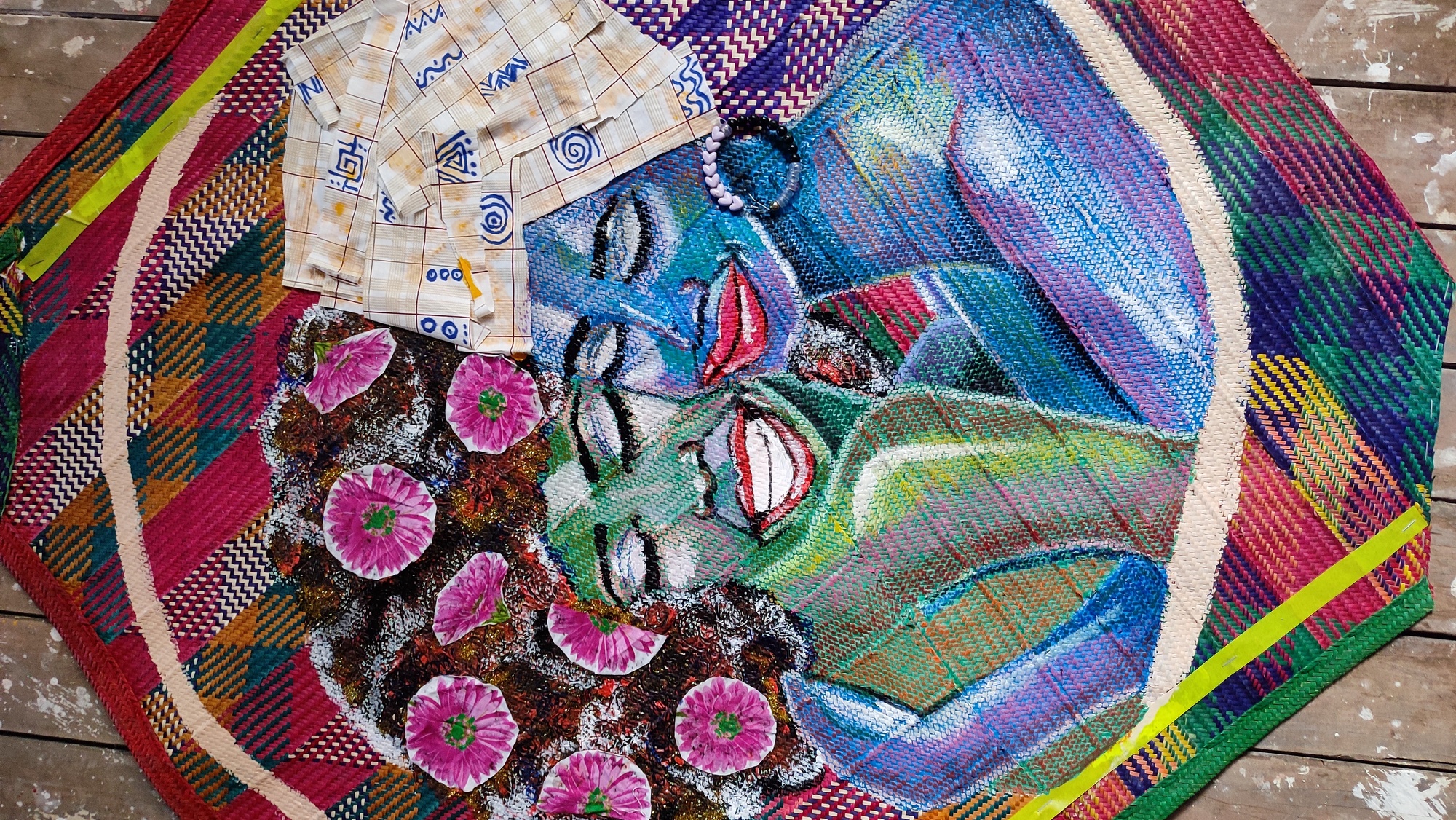
You play with different media because their materiality speaks to you and might carry a cultural meaning. In your last solo exhibition, you used Ugandan woven mukeka mats as a medium for your painting, which also represents intangible cultural heritage. Can you describe their meaning for you as a Ugandan woman?
I think of those woven mats as the very pulse of home, like a lattice of memory under my brush. As a Ugandan woman, these mats are not just utilitarian, they're family heirlooms, symbols of community, gathering, and daily ritual. By choosing them, I am weaving ancestral wisdom directly into your art, each stroke of paint a dialogue between past and present, each a silent keeper of a woman's strength.

Are there bodies of water that you hold dear and with which you have a special relationship?
I think there's a quiet gravity in places like Lake Tanganyika and Lake Bunyonyi, the River Nile, and the Buujjagaali falls. These water bodies are the vast, ancient mirrors of time, like a silver thread that stretches between generations. From afar, I feel its gravity, a longing like a dream current pulling me toward its shores. Some day, when I stand beside it, I'll realise that even that distance was part of my journey.